
Space weather glossary
If you are puzzled by any space weather terminology, have a look at our glossary.
A B C D E F G H I J K L M N O P Q R S T U V W X Y Z
A
- Active Region
-
- Areas of the Sun with rapidly changing magnetic activity. They have the potential to produce coronal mass ejections and solar flares.
- Advanced Composition Explorer (ACE)
-
- A space weather spacecraft launched in 1997 orbiting at L1. Its objective is to observe particles of varying origins to provide near-real-time information on solar wind conditions.
- Aurora Borealis / Aurora Australis
-
- The Northern/Southern lights, caused by interactions between the solar wind and the Earth's magnetic field.
C
- Corona
-
- The outer atmosphere of the sun with low density and high temperature. Visible as an extended bright region around the sun during solar a solar eclipse.
- Coronal hole
-
- A region of the corona with relatively low density and temperature. Coronal holes are the source of high speed solar wind streams.
- CME
-
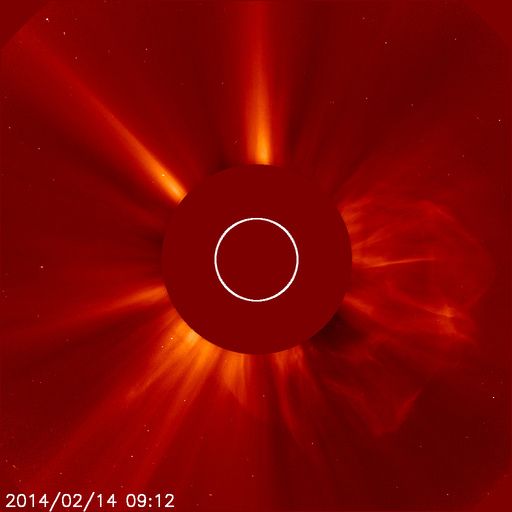
- An ejection of material from the sun’s surface into interplanetary space. If the material is directed towards the Earth, the event may result in a geomagnetic storm.
D
- Deep Space Climate Observatory (DSCR)
-
- A space weather spacecraft launched in 2015, orbiting at L1. Its objective is to easure solar wind density, velocity and temperature to provide high-reliability warnings of incoming geomagnetic storms.
- D-region
-
- The lowest layer of the ionosphere, only existing during daylight hours. HF absorption is strongest in this region.
E
- Electromagnetic spectrum
-
- A continuous spectrum of energy waves of varying wavelengths, travelling at 300,000km/s (the speed of light). In order of decreasing wavelength, the spectrum includes: radio waves, microwaves, infrared, visible light, ultraviolet, x-rays and gamma waves.
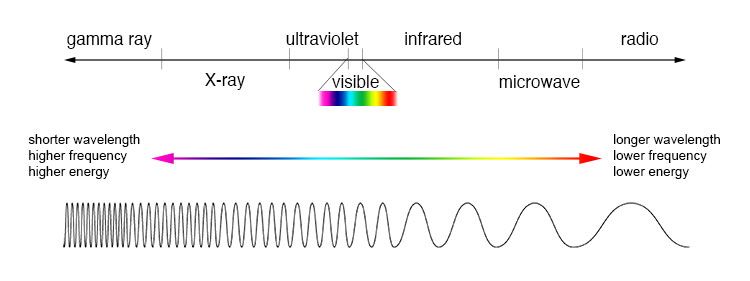
- Image: NASA's Imagine the Universe
- Electron
-
- A negatively charged subatomic particle.
F
- Filaments
-
- Arcs of plasma on the sun’s surface. Filaments observed on the edge of the sun are known as prominences. Occasionally, a filament may burst, emitting bright plasma from the sun’s surface. This is known as a 'filament eruption'.
G
- Geomagnetic field
-
- The magnetic field around the Earth. Geomagnetic field lines can be approximated to that of a simple bar magnet.
- Geomagnetic storm
-
- A temporary disturbance in the Earth’s magnetosphere caused by a large burst of solar wind which interferes with the Earth’s magnetic field.
- Geostationary Environment Satellite System (GOES-13/ GOES-15)
-
- Space weather spacecrafts, launched respectively in 2006 and 2010, at geosynchronous orbit. Their objective was to monitor near-Earth space for space weather. They were the precursor to DSCOVR.
- Geosynchronous orbit
-
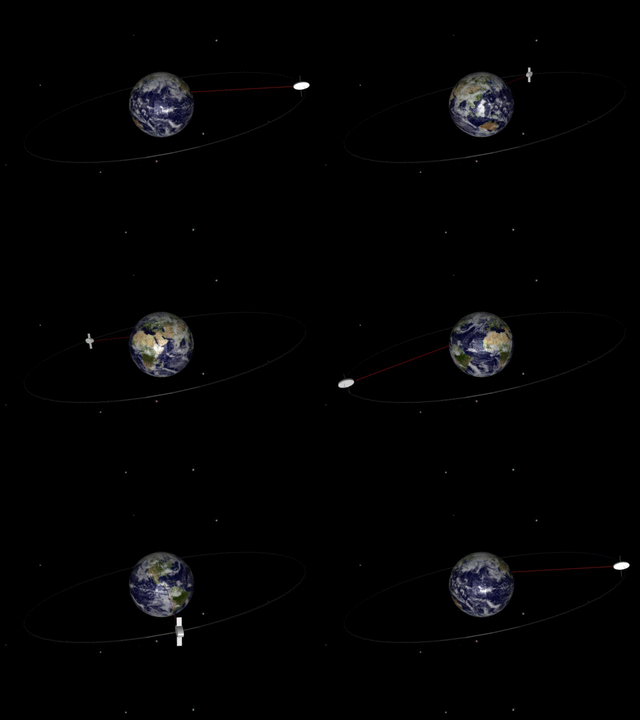
- A circular orbit above the Earth’s equator, with a period of 24 hours. The result is that the orbiting body permanently remains above the same position on Earth.
- GNSS/GPS
-
- Global Navigation Satellite System. The Global Positioning System (GPS) is an example of GNSS.
H
- Heliosphere
-
- A region of space in which solar wind has a significant influence. This region encompasses the entirety of the solar system.
- Heliocentric orbit
-
- The orbit of an object around the sun.
- HF
-
- Communication systems relying on the use of high frequency (HF) radio waves.
I
- Ionosphere
-
- The region of the Earth's atmosphere exposed to ionising radiation. It ranges from 60km to 1,000km in altitude.
L
- L1
-
- A point on the Sun-Earth line, 1.5 million km from the Earth. Gravitational stability in this region results in a stable orbit.
M
- Magnetogram
-
- An image displaying the strength and location of magnetic field regions on the sun.
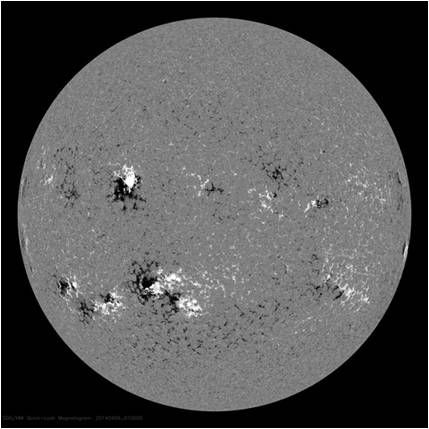
- Image: Courtesy of NASA/SDO and the AIA, EVE, and HMI science teams.
- MOSWOC
-
- Met Office Space Weather Operations Centre.
N
P
- Plage
-
- Bright and hot patches in the Sun's chromosphere. Plage are associated with concentrations of magnetic fields and sources of strong ultraviolet radiation.
- Plasma
-
- A super-heated, ionised gas of charged particles, accounting for 99% of all visible matter in the Universe.
- Proton
-
- A positively charged subatomic particle.
R
- Radio blackout
-
- During a large space weather event, the ionosphere may start to absorb HF radiation instead of reflecting it. This causes problems with communication systems.
- Radio waves
-
- Low energy electromagnetic radiations, used for long distance communication.
S
- Solar and Heliospheric Observatory (SOHO)
- Solar cycle
-
- The 11-year periodic change in the sun’s activity, including changes in the levels of radiation and solar wind emitted.
- Solar Dynamics Observatory (SDO)
-
- A space weather spacecraft launched in 2010, orbiting at an inclined geosynchronous orbit. Its objective is to image the Sun across different wavelengths to detect features appearing at varying depths of the Sun’s surface and investigate the causes of solar variability.
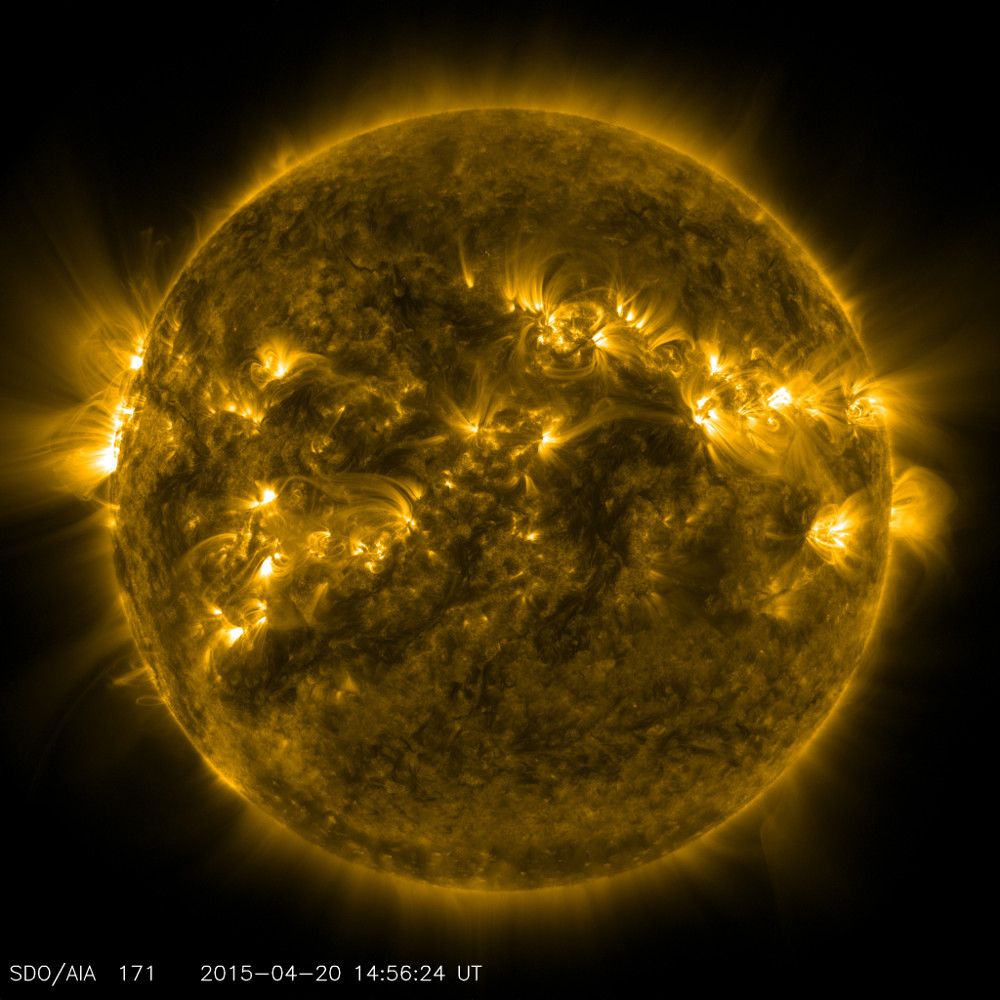
- Image: Courtesy of NASA/SDO and the AIA, EVE, and HMI science teams.
- Solar flare
-
- The sudden release of magnetic energy in the form of electromagnetic radiation, originating from the sun’s atmosphere.
- Solar radiation storm
-
- Interactions between charged particles (predominantly protons and electrons) and the Earth’s magnetic field. The charged particles originate from the sun following a solar flare or coronal mass ejection, and travel at 1/3 the speed of light.
- Solar Terrestrial Relations Observatory (STEREO)
-
- A space weather spacecraft launched in 2006, at heliocentric orbit. Its objective is to Study space weather through stereoscopic views of the Sun.
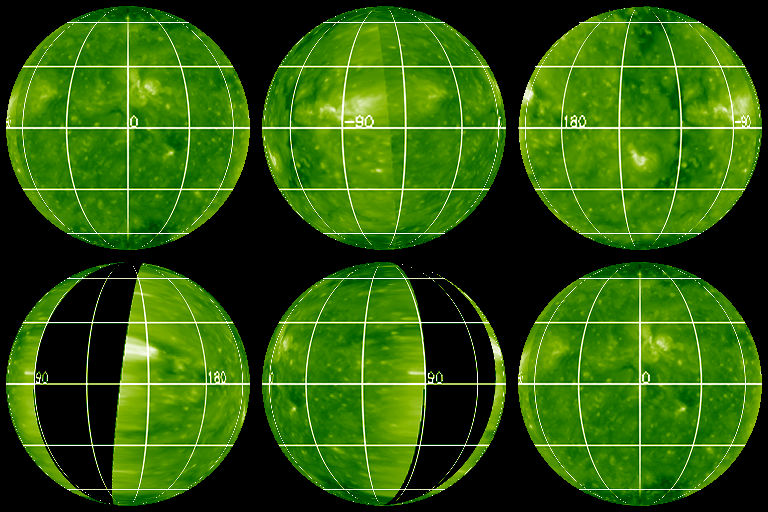
- Image: Courtesy of STEREO consortium
- Solar wind
- Sunspot
-
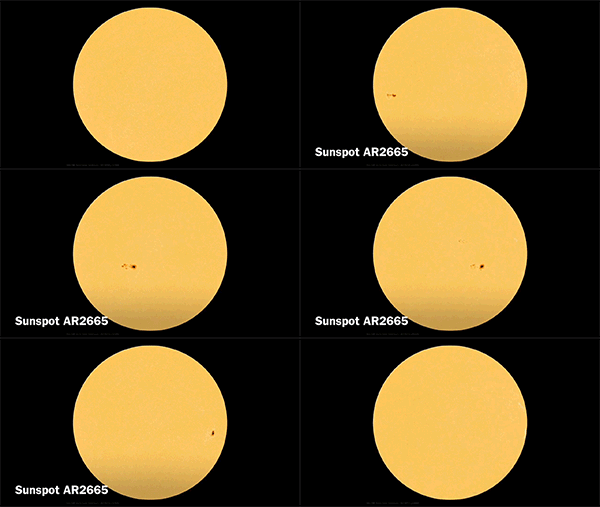
- A region on the sun’s surface with a concentrated magnetic field, resulting in lower temperatures and a darker colour.
- SWPC
-
- Space Weather Prediction Centre, NOAA.
X
- X-ray
-
- A burst in high energy electromagnetic radiation from the sun, causing radio blackouts on Earth