
High and low pressure
High and low pressure systems cause day-to-day changes in our weather. In this article, we look at how they are defined and how they form.
Blocking patterns and the jet stream play crucial roles in how these systems move and persist. Understanding these dynamics helps explain the variety of weather experienced across regions and seasons.
High and low pressure systems are fundamental drivers of day-to-day weather changes. Atmospheric pressure is the force exerted by the Earth's atmosphere on its surface, measured in hectoPascals (hPa) or millibars. Standard sea-level pressure is 1013 hPa, but large areas of higher or lower pressure can develop, defined relative to their surroundings.
How pressure is visualised
Weather charts use isobars—lines connecting points of equal sea-level pressure—to identify features like anticyclones (high pressure) and depressions (low pressure).
Formation of pressure systems
Pressure systems are shaped by the movement of air:
- Ascending air (as it warms) creates low pressure at the surface.
- Descending air (as it cools) creates high pressure at the surface.
Generally, low pressure brings unsettled weather, while high pressure leads to settled conditions.
Characteristics of high and low pressure
High pressure (Anticyclone)
- Winds tend to be light and blow clockwise in the northern hemisphere.
- The descending air reduces cloud formation, resulting in settled weather.
Low pressure (Depression)
- Air is rising and circulates anticlockwise in the northern hemisphere.
- The rising air cools, causing water vapour to condense into clouds and precipitation.
- Weather is often unsettled, with associated weather fronts.
Blocking patterns
Sometimes, high pressure systems become stationary, distorting the usual west-to-east movement of weather fronts. This is called a ‘block.’ When blocking occurs, high pressure can keep weather fronts at bay, resulting in prolonged dry and settled weather for some areas, while in the area where the weather fronts are, others experience extended wet and windy conditions.
Causes of blocking
A weak or displaced jet stream can allow high pressure to dominate. The jet stream, driven by temperature differences, steers low pressure systems. If it weakens or shifts, high pressure can become persistent. Sudden Stratospheric Warming events can also alter wind patterns, sometimes bringing easterly winds and stubborn high pressure.
Types of blocking
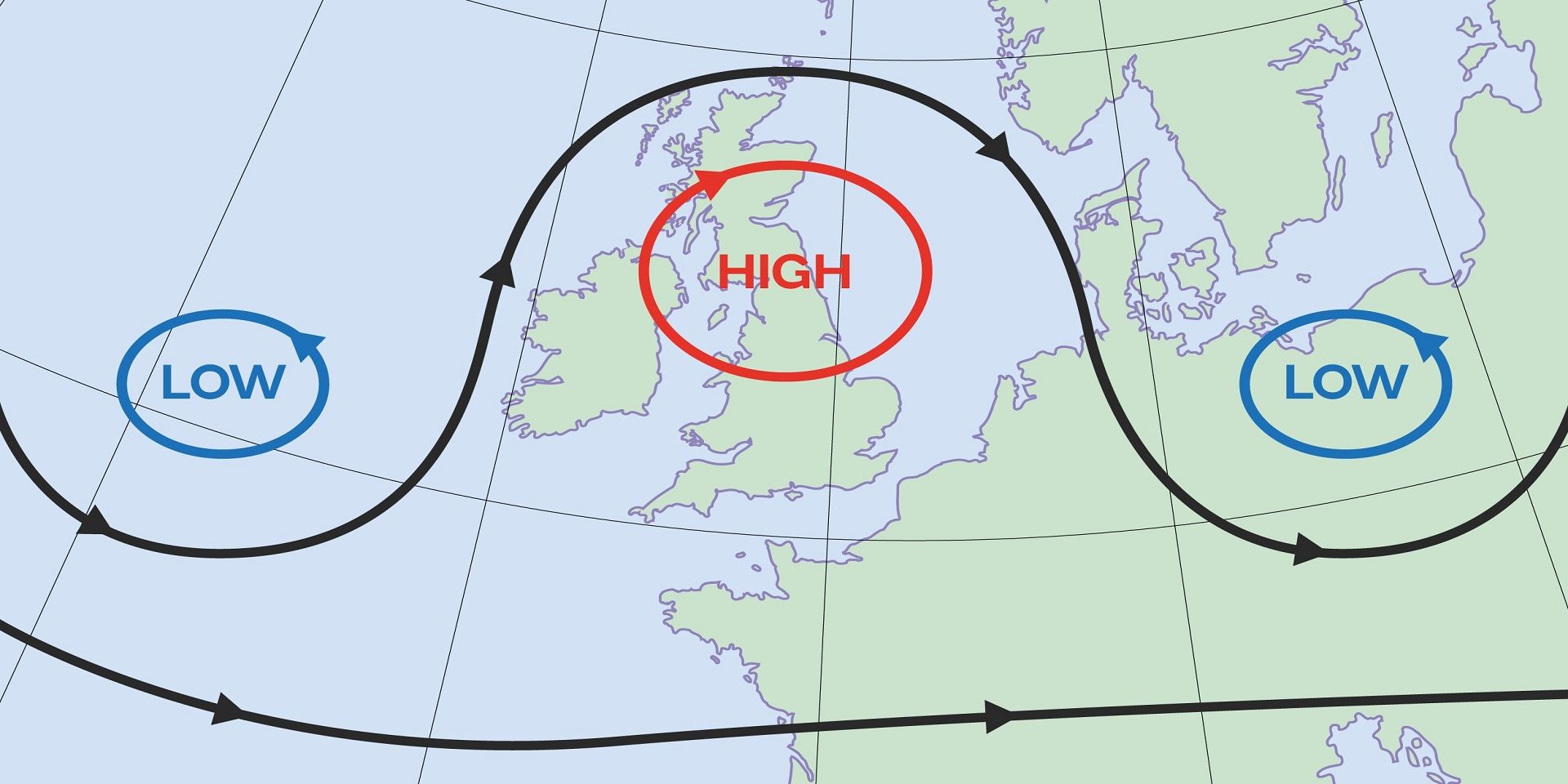
Omega block
Named for its resemblance to the Greek letter Ω, this pattern features high pressure sandwiched between two lows to the east and west, and also slightly to the south. It often brings easterly flows to regions like the UK.
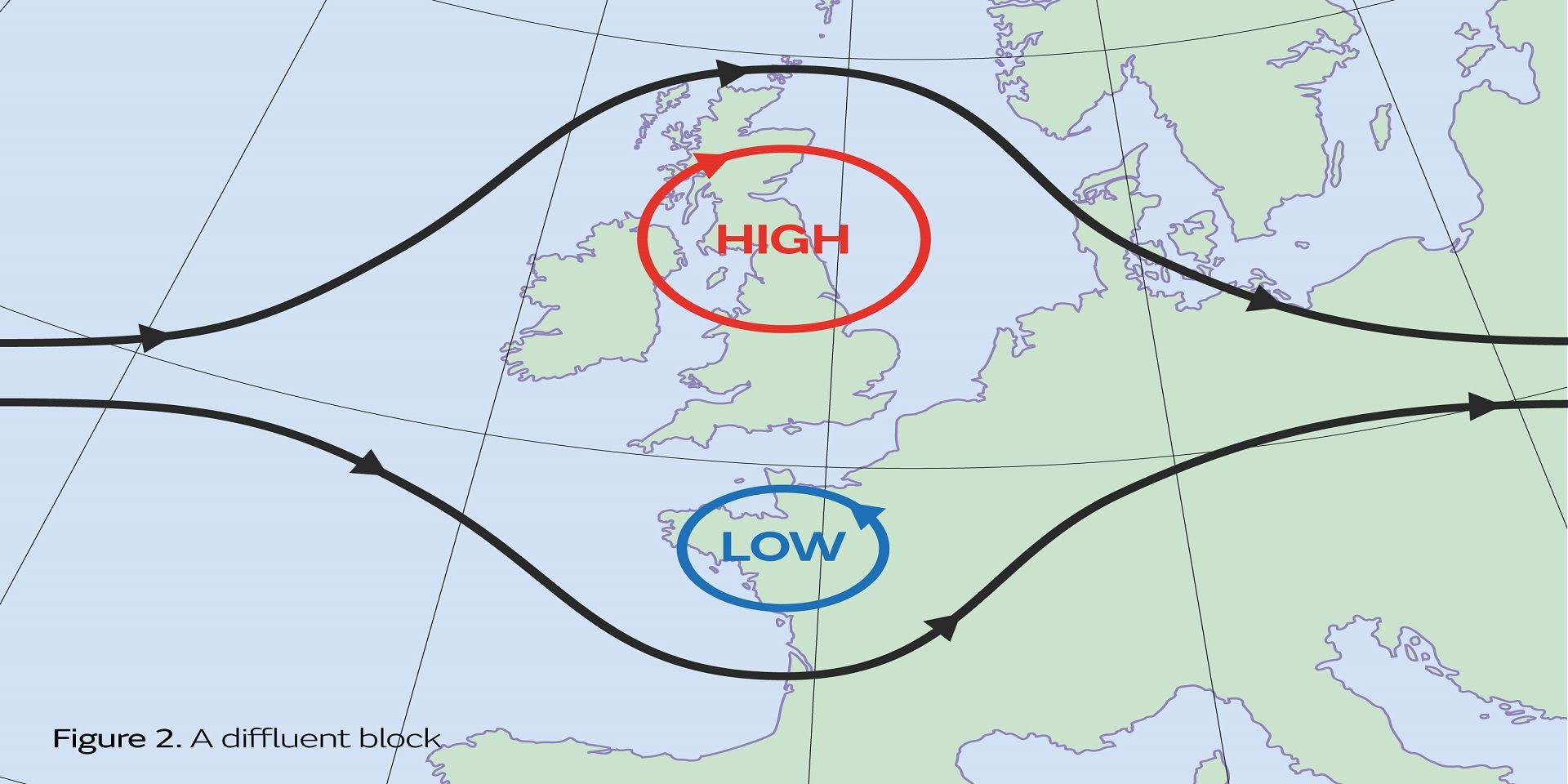
 Diffluent block
Occurs when the eastward flow splits, with a closed high centre to the north of a closed low centre in the south. These blocks can persist for long periods.
Weather conditions associated with pressure systems
| High pressure | |
| Summer | Winter |
|
|
| Low pressure | |
| Summer | Winter |
|
|
Wind flow and pressure
Wind is driven by the pressure gradient force, moving from high to low pressure regions. The greater the difference in pressure (the pressure gradient), the stronger the wind. However, the In reality, the Coriolis effect—caused by Earth’s rotation—deflects wind to the right in the northern hemisphere and to the left in the southern hemisphere, creating spiral wind patterns around pressure systems.
The Intertropical Convergence Zone (ITCZ)
The ITCZ is a band of low pressure near the equator where trade winds from the northern and southern hemispheres converge, leading to frequent thunderstorms and heavy rain. Air rises along the ITCZ, moves toward the poles, and descends in the subtropics, forming the Hadley Cell. The ITCZ shifts with the seasons, following the migration of the Sun’s position, and is historically known by seafarers as the ‘doldrums’ for its calm winds.