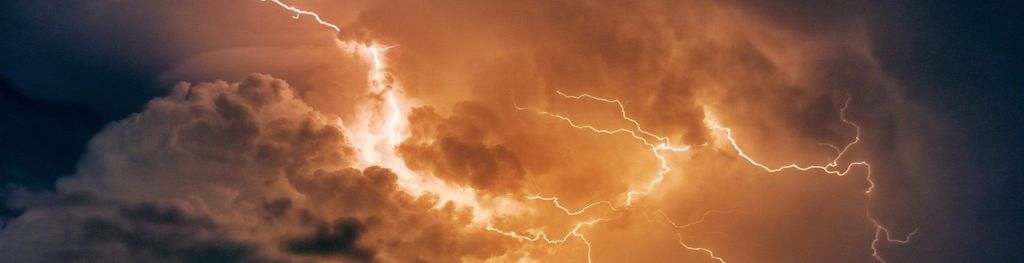
Thunder and lightning
A thunderstorm is a series of sudden electrical discharges resulting from atmospheric conditions. These discharges result in sudden flashes of light and trembling sound waves, commonly known as thunder and lightning.
Thunderstorms develop when the atmosphere is unstable. This is when warm air exists underneath much colder air. In the UK, thunderstorms can occur at any time of the year but the most severe usually occur in the summer months particularly after a couple of days of hot, humid and sunny weather.
Thunder and lightning are associated with convective clouds and are often accompanied by heavy rain or hail.
Where do thunderstorms form?
Thunderstorms are common occurrences on Earth. It is estimated that a lightning strike hits somewhere on the Earth's surface approximately 44 times every second, a total of nearly 1.4 billion lightning strikes every year.
Owing to the fact thunderstorms are created by intense heating of the Earth's surface, they are most common in areas of the globe where the weather is hot and humid. Landmasses, therefore, experience more storms than the oceans and thunderstorms are also more frequent in tropical areas than the higher latitudes.
In the UK thunderstorms are most common over the East Midlands and the southeast.
How far away is a thunderstorm?
Thunder will always be heard after the lightning strike is seen because light travels significantly faster than sound. Both the lightning and thunder clap are generated simultaneously but with the speed of light at 299,792,458 m/s and the speed of sound at 340.29 m/s, there will always be a gap between the two to the observer.
Your distance from a thunderstorm can be estimated by measuring the time between seeing the lightning flash and hearing the start of thunder. The length of this interval in seconds can be divided by five to give an approximate distance in miles (or divide by three for kilometres).
Sometimes lightning may be seen but there is no thunder heard. This is either because thunder is rarely heard more than 20 km away or because the atmospheric conditions lead to sound bending upwards and away from the surface.
What is thunder?
Thunder is the sound produced by the rapid heating of air by a lightning strike.
When lightning strikes, the narrow channel of air through which it travels reaches temperatures of up to 30,000 °C almost instantly – that's five times hotter than the surface of the Sun. This intense heating causes the air to rapidly expand outward into the cooler air surrounding it, creating a rippling shockwave which we hear as a rumbling thunder clap.
Depending on its formation and location, this thunder clap can be heard as either a sudden, loud crack or a low, long rumble. Thunder lasts longer than lightning due to the time it takes for the sound to travel from different parts of the lightning channel.
The intensity and type of sound heard by the listener depends upon the conditions on the atmosphere and how close the listener is to the lightning - the louder the thunder, the closer the lightning.
When a lightning strike is close, the thunder is heard as a loud clap or snapping sound. When the sound of thunder has a rumbling quality, it is the sound waves reaching the listener at different times owing to the shape of the lightning strike. In rare cases, the sound of thunder at very close range has been known to cause injury to humans and damage to property.
Thundersnow
When thunderstorms form in wintry conditions they can sometimes give rise to heavy downpours of snow which are often called 'thundersnow'.
When thundersnow occurs at night the lightning appears brighter - this is because the light reflects off the snowflakes.
The snow contained within the thunderstorm acts to dampen the sound of the thunder meaning it will only be heard if you are within 2 to 3 miles of the lightning.
What is lightning?
Lightning is a huge electrical discharge that flows between clouds, from a cloud to air, or from a cloud to the ground.
What causes lightning?
As tiny water droplets form inside a storm cloud, they are propelled towards the top of the cloud by strong internal winds, called updraughts, where they turn to ice. Some of the pieces of ice grow into hail, but others remain very small. Some of the hail that forms becomes too heavy to be propelled by the updraughts and so begin to fall back through the cloud, bumping into smaller ice particles as they do so. During these collisions, electrons are transferred to the hail giving the hail a negative charge, while the ice particles that have lost electrons gain a positive charge.
The updraughts continue to carry the ice particles upwards, giving the top of the cloud a positive charge. The hail continues to fall through in the lower part of the cloud, giving it a negative charge. As well as being attracted to the positive charge in the top of the cloud, the surplus of electrons in the cloud base are attracted to positive charge in other clouds and on the ground. If the attraction is strong enough, the electrons will rapidly move towards the positive atoms. The path they make in doing so forms the channel we see during a flash of lightning.
As negative charge builds at the base of the cloud, the electrons near the ground's surface are repelled. This leaves the ground and the objects on it with a positive charge. As the attraction between the cloud and the ground grows stronger, electrons shoot down from the cloud cutting through the air at around 270,000 miles per hour.
Lightning flashes and lightning strikes
Although often assumed to be the same thing, there is a key distinction between lightning flashes and lighting strikes. A lightning flash is what you can see, but this is often made up of several individual lightning strokes which are pulses of current that occur separately only hundredths of a second apart. The term lightning 'strike' refers to cloud-to-ground lightning, where lightning 'strikes' the ground.
While the intensity of a lightning strike can make them appear as thick bolts across the sky, the actual width of a lightning bolt is only about 2-3 cm. The average length of a lightning bolt is about 2-3 miles.
A bolt from the blue
Most lightning strikes originate from the negative part of a cloud, however, occasionally a strike can come from the positively charged top part - this is called 'positive lightning'. When positive lightning strikes, it is forced to go around the negatively charged base of the cloud. This generally results in a more powerful lightning strike which shoots out sideways and sometimes can travel a mile more away from the storm cloud before connecting with the ground. The nature of this type of lightning strike is where we get the term 'a bolt from the blue'.
Detecting lightning
Being able to detect the location of thunderstorms is important as it is not only the lightning strike that is dangerous, but many other factors linked to thunderstorms. These include intense rain and tornadoes.
When lightning strikes it sends out pulses of radio waves, and these can be used to detect lightning strikes. The Met Office LEELA (Lightning Electromagnetic Emission Location by Arrival time difference) system detects these pulses at a frequency known as VLF (Very Low Frequency) - much lower frequency than normal radio waves.
These pulses are known as 'sferics' and can travel great distances because they are reflected between the surface of the Earth and a layer of the upper atmosphere called the ionosphere - in a similar way to light travelling within a fibre optic cable.
An individual sensor can detect a sferic, but in order to determine a thunderstorm's exact location, a network of sensors is required (e.g. the LEELA system network of 11 sensors positioned around Europe). When a strike occurs, the network of sensors will pick up the sferic at slightly different times and through a technique known as multi-lateration, these readings can be used to determine the exact location of the thunderstorm. The difference in the time taken for the sferic to reach one sensor relative to another is called the ATD (Arrival Time Difference).
Types of lightning
- Rocket lightning - a very rare and unexplained form of lightning in which the speed of propagation of the lightning stroke is slow enough to be perceptible to the eye.
- Pearl-necklace lightning - a rare form of lightning, also termed 'chain lightning' or 'beaded lightning', in which variations of brightness along the discharge path give rise to a momentary appearance like pearls on a string.
- Ribbon lightning - ordinary cloud-to-ground lightning that appears to be spread horizontally into a ribbon of parallel luminous streaks when a very strong wind is blowing at right angles to the observer's line of sight.
- Forked lightning - lightning in which many luminous branches from the main discharge channel are visible.
- Sheet lightning - the popular name applied to a 'cloud discharge' form of lightning in which the emitted light appears to diffuse and there is an apparent absence of a main channel because of the obscuring effect of the cloud.
- Streak lightning - a lightning discharge which has a distinct main channel, often tortuous and branching, the discharge may be from cloud to ground or from cloud to air.