
Why the sky is blue and sunsets red
To understand why we see the sky as blue and sunsets as red or orange, we need to understand a little bit about how light is made up of a spectrum of colours.
The sky appears blue because of a phenomenon called Rayleigh scattering. Sunlight, although it looks white, is actually made up of many colours, each with a different wavelength. At one end of the spectrum is red light which has the longest wavelength and at the other are blue and violet light which have a much shorter wavelength. When sunlight enters Earth’s atmosphere, it collides with tiny gas molecules - mainly nitrogen and oxygen. These molecules are much smaller than the wavelength of visible light, so they scatter shorter wavelengths much more than longer wavelengths.
Even though violet light is scattered even more than blue, our eyes are more sensitive to blue, and there’s less violet in sunlight to begin with. That’s why we see a blue sky instead of a purple one.
Why does the blue fade at the horizon?
The sky looks most vibrant overhead and paler near the horizon. This happens because light from the horizon travels through more atmosphere, getting scattered and re-scattered along the way. The increased scattering mixes in more white light, making the blue less intense.
Why are sunsets red or orange?
Again, this is to do with Rayleigh scattering and the fact that light is made up of many different colours of differing wavelengths.
Blue and violet light gets scattered more than other colours because it travels as shorter, smaller waves. At sunrise and sunset, the Sun is low in the sky, so its light passes through a thicker layer of atmosphere. The shorter wavelength blue light is scattered further, as the sunlight passes over a greater distance, and we see the longer wavelengths—reds and oranges—that create those beautiful sunset and sunrise colours.
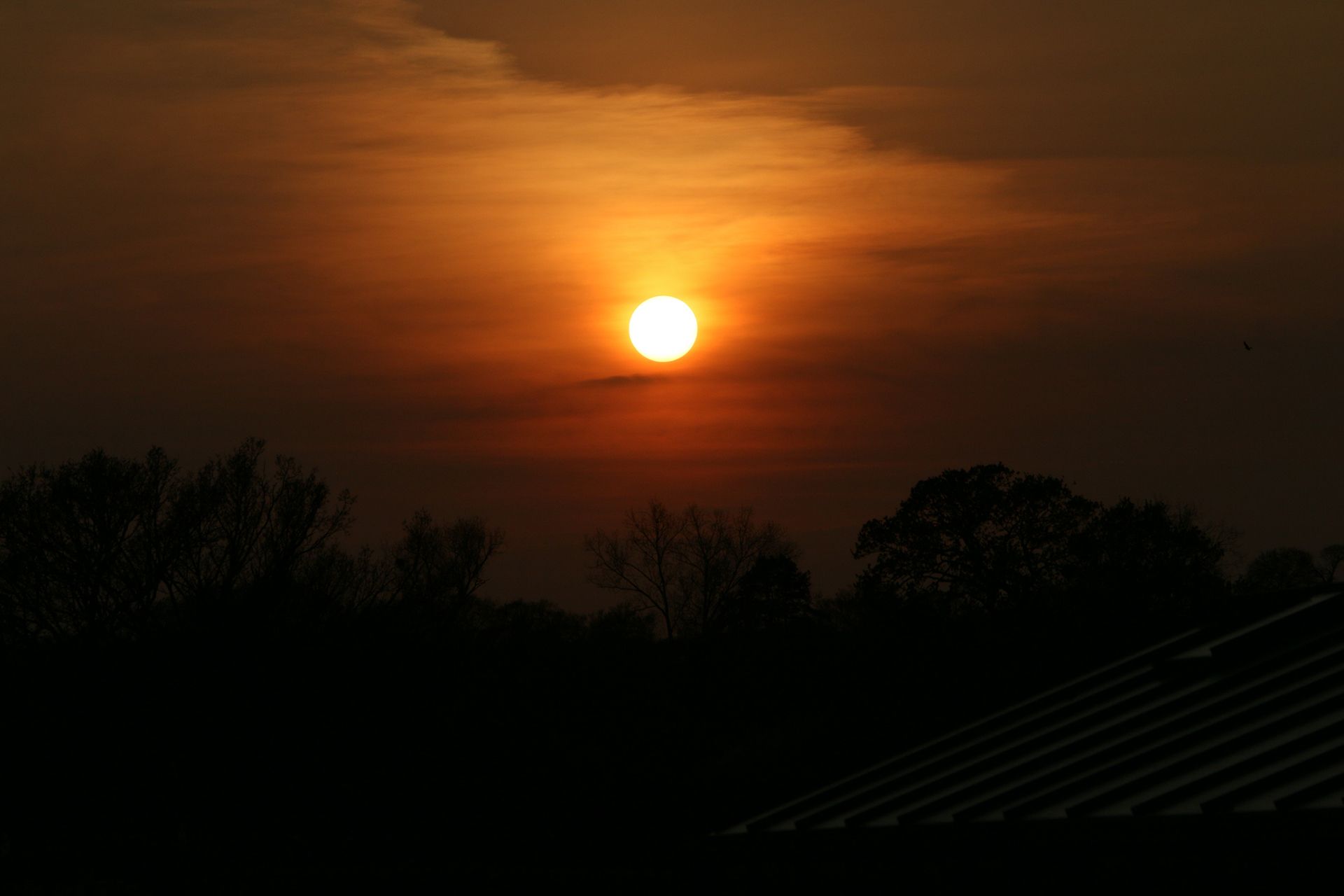 In summary, the colours we see in the sky are all about how sunlight interacts with the atmosphere. Blue skies and red sunsets are both results of the same scattering process, just seen from different angles and at different times of day.